
































































































































































































































































































Europe’s AI Act Sets a Global Benchmark



Europe finalizes sweeping AI rulebook
Europe has completed work on the Artificial Intelligence Act, a far-reaching law that sets detailed rules for how AI can be built and used in the European Union. The measure entered into force in 2024 and will roll out in phases through 2026. The European Commission has described the package as “the world’s first comprehensive AI rulebook”. Policymakers say the goal is to promote innovation while protecting people from harmful or opaque AI.
The law arrives during a surge in AI adoption across industries. From healthcare and finance to retail and government, organizations are using machine learning and generative models to speed decisions and generate content. Regulators in Europe, the United States, and Asia are responding with new frameworks that put guardrails around high-risk uses and require more transparency from model developers.
How the law works: risk tiers and obligations
The AI Act organizes systems by risk and assigns obligations that scale accordingly. The structure aims to be technology-neutral and future-proof, focusing on how systems are used rather than the algorithms themselves.
- Unacceptable risk: Uses that threaten rights or safety are banned. Examples include social scoring by public authorities and some forms of biometric categorization using sensitive traits. Restrictions also cover real-time remote biometric identification in public spaces, with narrow exceptions.
- High risk: AI used in critical areas—such as medical devices, employment, education, law enforcement, migration, and essential infrastructure—must meet stringent requirements. These include risk management, high-quality data governance, technical documentation, logging, human oversight, robustness, and cybersecurity.
- Limited risk: Systems like chatbots and AI-generated content tools must provide transparency so people know they are interacting with AI.
- Minimal risk: Most AI applications, such as spam filters or recommendation engines, face no new obligations beyond existing laws.
Developers of general-purpose AI (GPAI), including large language models, face additional duties. They must provide technical documentation to downstream providers, disclose information to support safe integration, and respect EU copyright rules—such as publishing summaries of training data sources. Very large models with systemic risk may have to perform model evaluations, report serious incidents, and apply state-of-the-art security safeguards.
Phased timeline and enforcement
The rules take effect in stages. Prohibited practices are enforced first, followed by transparency obligations for limited-risk systems. High-risk requirements and most GPAI duties arrive later, allowing companies time to adjust. National supervisory authorities will oversee compliance, with coordination by a new EU-level office focused on advanced models. Penalties for serious violations can be significant, mirroring the deterrent approach used in EU privacy law.
Regulators argue the runway is necessary. It gives public agencies time to designate high-risk use cases and build capacity for audits. It also lets small and mid-size firms adapt without halting innovation. Industry groups say clarity on timing helps them plan budgets for compliance teams, documentation tools, and model testing.
Global spillover from EU rules
Like the EU’s privacy regulation, the AI Act is expected to influence practices beyond Europe. Global companies often standardize to the strictest rule to simplify engineering and documentation. That could mean broader adoption of AI risk assessments, dataset provenance tracking, and plain-language disclosures about how systems work and where their limits are.
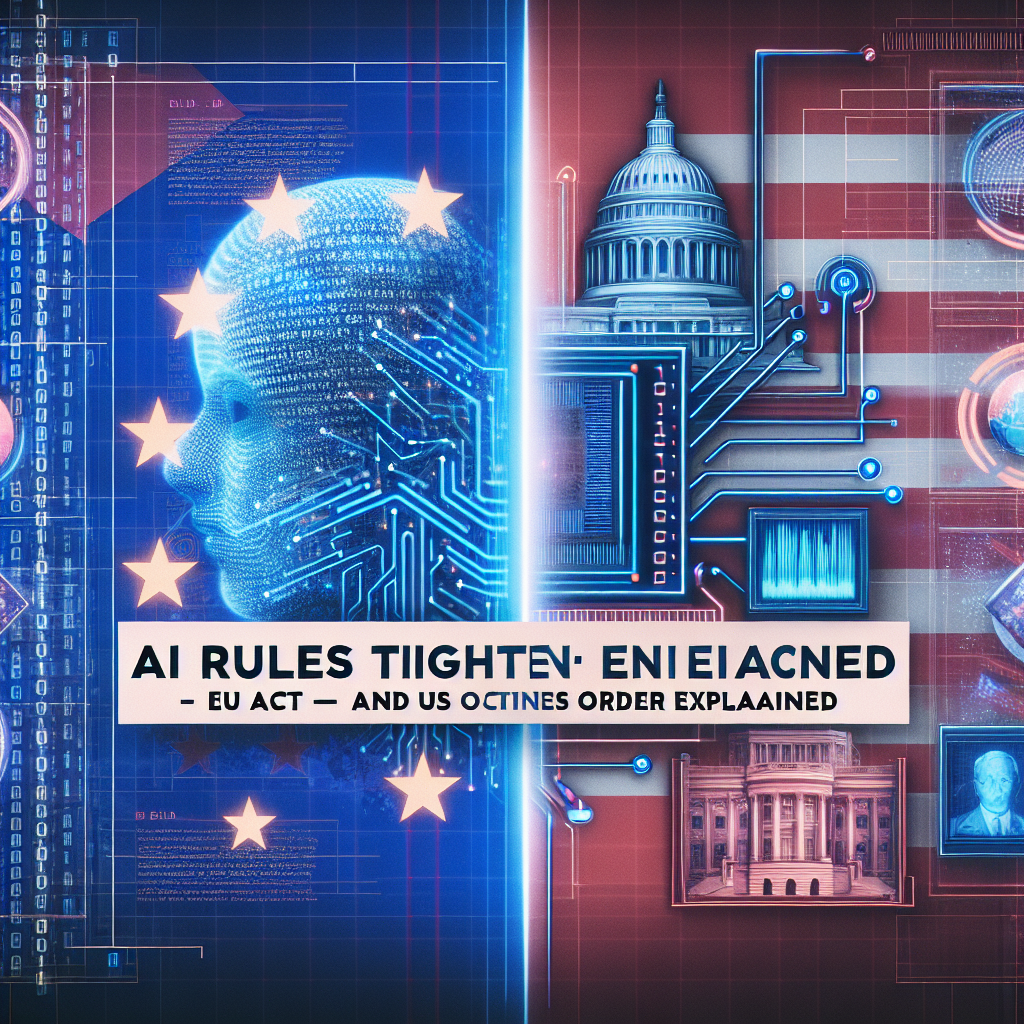
The United States has moved on parallel tracks. In October 2023, the White House issued an executive order that, according to its fact sheet, “establishes new standards for AI safety and security” and aims to protect privacy and civil rights. Federal agencies have since developed guidance for testing, procurement, and incident reporting. The National Institute of Standards and Technology (NIST) released a voluntary AI Risk Management Framework to help organizations evaluate and mitigate harms. The United Kingdom created an AI Safety Institute to examine cutting-edge models and share testing methods internationally. Together, these steps point to emerging alignment on core practices—such as red-teaming, documentation, and post-deployment monitoring—even as legal obligations differ by jurisdiction.
What will change for companies
- More documentation: Firms deploying high-risk systems will need detailed technical files, including data lineage, model assumptions, and performance metrics across populations.
- Testing and monitoring: Pre-release evaluation and ongoing audits will become standard. Expect more adversarial testing and robustness checks for general-purpose models integrated into critical workflows.
- Human oversight by design: Systems must include controls that let human operators understand outputs, intervene, or reverse decisions when needed.
- Transparency to users: Clear notices when content is AI-generated or when users interact with a chatbot, along with instructions for recourse.
- Supplier scrutiny: Procurement teams will ask for model cards, system cards, or equivalent documentation, plus evidence of security and copyright compliance.
Legal teams are preparing playbooks that map AI use cases to risk tiers, assign accountability, and define escalation paths for incidents. Startups and open-source developers benefit from exemptions and lighter-touch duties in some areas, but many will still need to show responsible development practices to win enterprise customers.
Supporters see safety; critics see friction
Consumer advocates welcome the bans and the focus on transparency. They argue that AI can entrench discrimination if left unchecked and that oversight will spur better tools. Industry groups generally support clear rules but warn that overly broad definitions could capture low-risk tools and raise costs. Developers of open-source models worry that compliance burdens could chill community research if requirements are interpreted too strictly.
Governments are also debating how to evaluate **frontier models**. National safety institutes and regulators are building shared test suites for dangerous capabilities, including automated cyber intrusion, biological misuse assistance, or deceptive content generation. The central challenge is ensuring rigorous testing without restricting beneficial research or imposing barriers that only the largest firms can meet.
Why this matters
The AI Act pushes the sector toward repeatable, auditable engineering practices. It also advances the idea that explainability and non-discrimination are not optional features in sensitive domains. While compliance will require investment, the law could reduce uncertainty for buyers and citizens. By aligning with standards bodies and encouraging interoperable documentation, the EU aims to make trustworthiness measurable rather than aspirational.
The road ahead will hinge on implementation. Regulators must issue practical guidance. Companies need to integrate risk assessments into product cycles. And international coordination remains essential. With the EU setting strict market rules and the U.S., U.K., and others refining their own toolkits, a baseline for responsible AI is taking shape—one that insists on safety and transparency without closing the door to innovation.
What to watch next
- Sector-specific rules: How health, finance, and transportation regulators adapt the law to their domains.
- Frontier model testing: Development of common evaluation methods across the EU, U.S., and U.K.
- Small-business impact: Whether phased timelines and guidance keep compliance affordable for startups.
- Enforcement cases: Early actions that clarify gray areas and set precedents for documentation and risk thresholds.
- Global alignment: Whether trading partners adopt compatible approaches to transparency and safety.
However the details shake out, the direction is clear: AI builders will be expected to show their work. The EU’s move signals that guardrails are becoming part of the product, not an afterthought.